
Regional commercial banks are a vital component to funding business and innovation in the United States, but major structural forces are mounting an existential challenge to the current business model.
For more than a century, community banks have served as the financial backbone of American enterprise. The full range of the country’s growth businesses, from the veterinary clinic on Main Street to the tech startup in Silicon Valley, have relied on the banking system. Today’s banking industry exists along a continuum ranging from small community banks to global Wall Street monoliths. Regional banks occupy a critical middle ground in this ecosystem: large enough to extend meaningful credit, yet close enough to local markets to underwrite clients routinely overlooked by big banks.
This middle ground, however, is eroding. A confluence of factors is threatening regional banks from many directions: 1) technological disruption, 2) intensifying non-bank competition, 3) a changing funding model, 4) bureaucratic self-entanglement, and 5) a widening talent gap. These five threats represent as much structural challenge as the industry has faced since deregulation reshuffled the deck in the 1980s and banking consolidation began.
Technology: Running the Future on 1970s Systems
Stepping through the system architecture of a mid-size regional bank today is, in many ways, like going back decades in time. Approximately 43% of global banking systems still run core functions on COBOL code created in the 1970s and ‘80s. And that figure may be as high as 60% among institutions with assets over $50 billion. An estimated 220 billion lines of COBOL code remain in active operation globally, processing roughly $3 trillion in transactions daily. Unbelievably, over 95% of ATM swipes still rely on COBOL-based systems.
The problem is not merely aesthetic. Legacy infrastructure is a strategic straitjacket and merging newer technologies into the stack is nearly impossible. Further, data standardization from dated systems or a hybrid set of core technologies is fraught with error. Overall bank technology staff often fights a game of catch-up and system patches on legacy systems. More than three-quarters of banks report having minimal staff that can maintain legacy code—a single-point-of-failure risk that keeps IT departments awake at night. Meanwhile, as a regional bank’s technology team is negotiating with an architecture designed in the era of mainframes, a fintech competitor may be able to launch a new product in a matter of weeks.
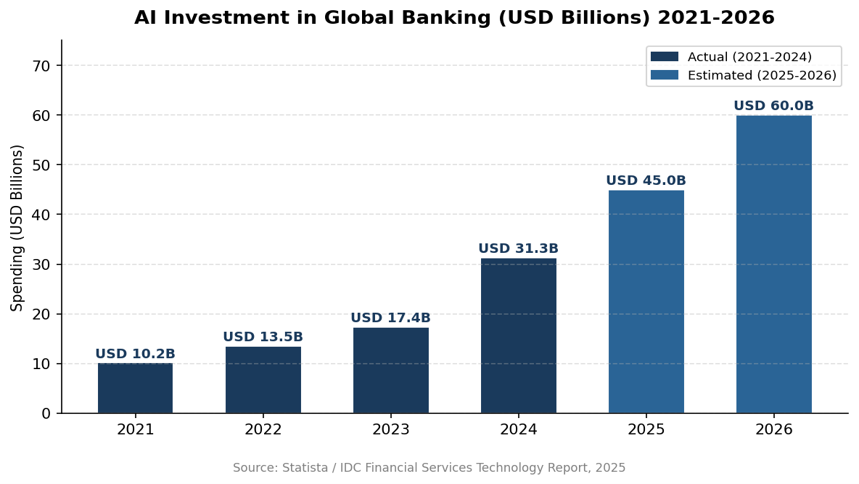
Compounding the legacy burden is the accelerating pace of artificial intelligence adoption. AI is not a distant threat; it is already reshaping the economics of banking. Some studies estimate AI could drive up to 20% in net cost reductions industry wide. JPMorgan Chase has already reported a 30% reduction in consumer servicing costs from AI deployments. Global banking AI investment reached $31.3 billion in 2024 and is on track to approach $60 billion in 2026. By 2028, AI could add $170 billion—or 9%—to the global banking sector’s profit pool.
For deep-resourced money-center banks, AI may be an accelerant. However, for regional banks trying to modernize while keeping the lights on, AI investment may be a widening competitive gap. Smaller budgets, data gaps, and a heightened need for prioritization are all constraints at a regional bank. Institutions that cannot integrate AI into credit underwriting, fraud detection, and customer service will face structurally higher cost ratios than larger peers—a compression that hits earnings at a time when margins are already thin and compressing.
Non-Bank Competition: The Wolves Are Inside the Gate
Regional banks have always competed with one another. What is new is the caliber and capital base of the competition arriving from outside the industry entirely.
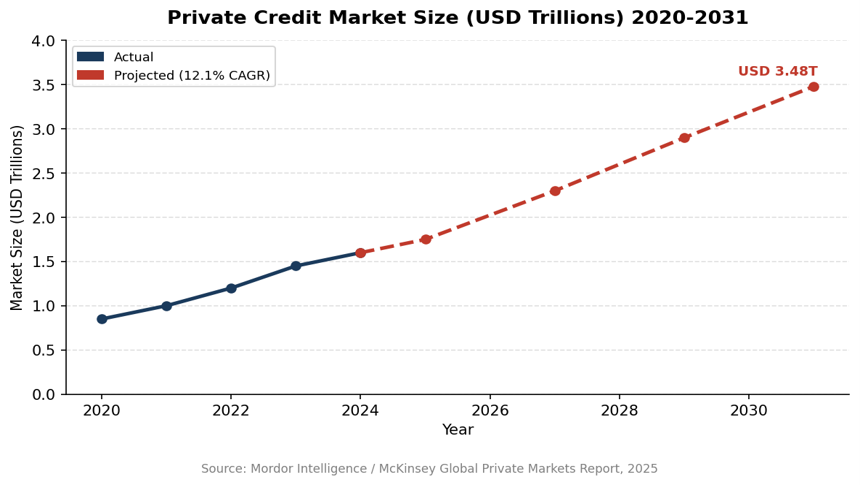
Private credit has emerged as the most direct assault on the regional bank lending franchise. The private credit market stood at $1.75 trillion at the start of 2025 and is projected to reach $3.48 trillion by 2031, compounding at 12.1% annually, according to Mordor Intelligence. Direct lending alone commands a 65% revenue share within that market. Private credit funds can move faster, hold larger single-name exposures, and price more flexibly than regulated depositories—advantages that are particularly acute in the middle-market commercial lending segment that regional banks have traditionally owned.
Fintech lenders add a second front. The global fintech lending market was valued at $1.16 trillion in 2024 and is projected to surpass $10 trillion by 2033, growing at a 27.4% CAGR. These platforms underwrite using alternative data, deliver approvals in minutes, and operate at cost structures unencumbered by branch networks or compliance departments. While most fintech lenders have bank funding partners, the structure typically disintermediates the client relationship, leaving the bank partner as a commodity rather than a trusted adviser.
Then there are the technology giants. Apple, Microsoft, Amazon, and Meta have steadily built financial services footprints that bypass the need for a bank charter. Apple’s high-yield savings account attracted billions in deposits within weeks of its 2023 launch. And while these deposits sit at a bank, the Apple brand showed a serious trust preference for a technology company versus a banking institution from retail customers. Similarly, Apple Pay currently accounts for 13.5% of the retail online payments market. Beyond retail, Amazon extends business loans to merchants and processes payments through Amazon Pay. As of 2020, 61% of bank and credit union executives identified Big Tech as the single largest competitive threat over the coming decade—and that was before the current wave of AI-enabled financial products. The irony is not lost on regional bankers: the very technology vendors that may provide cloud infrastructure and software for banks are simultaneously competing for bank customers.
The Funding Model: Deposits Are Not Coming Back the Same Way
Deposits are the raw material of banking. Without a stable, low-cost deposit base, a bank cannot lend. And without lending banks cannot generate the net interest income that drives most regional bank earnings. This funding equation is under structural pressure from two directions simultaneously.
The first is a secular trend three decades in the making. Since the early 1990s, the proliferation of money market funds and the rise of discount brokerages have progressively disintermediated savings away from bank deposits and into the capital markets. This disintermediation has accelerated post-pandemic. When the Federal Reserve raised rates aggressively in 2022 and 2023, deposits flowed out in a search for yield that the banks could not (or would not) match. And, after the SVB collapse, deposits migrated disproportionately to the four largest banking institutions over concern for regional bank franchise risk. Such large national banks often offer robust digital platforms, ubiquitous branch access, and marketing budgets that dwarf a regional bank’s entire operating expense line.
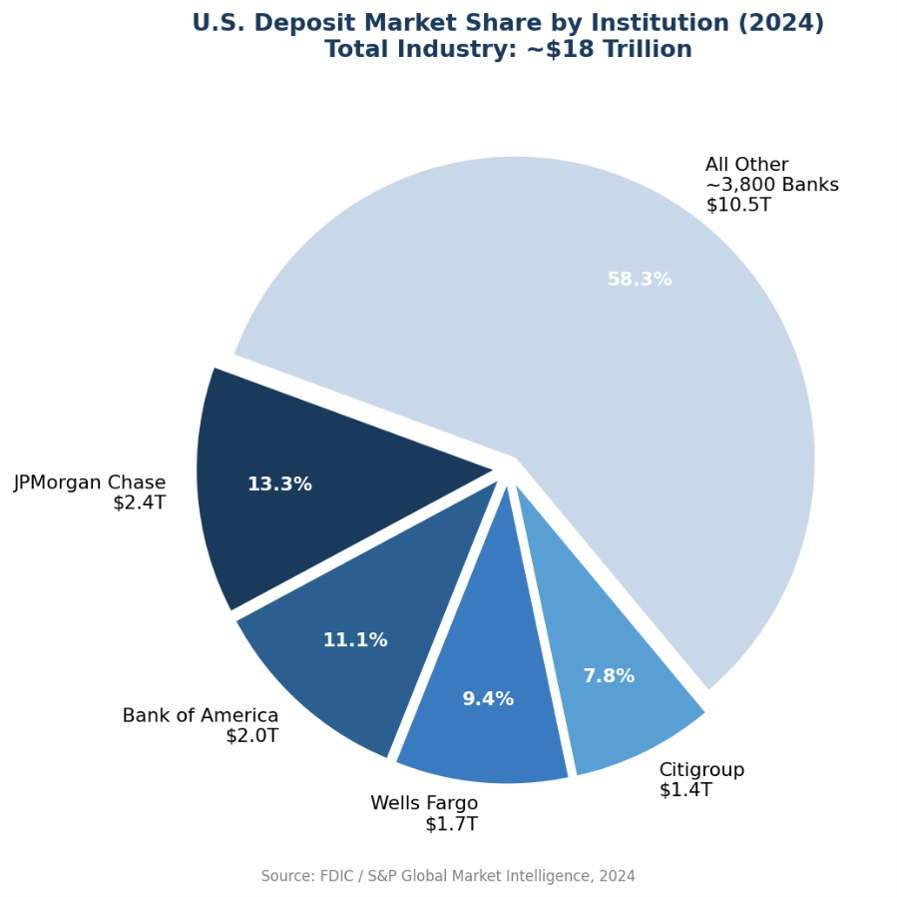
The numbers are stark. The top four banking institutions together control more than 40% of total industry deposits – $7.5 trillion—a concentration that would have been unthinkable when regulators debated interstate banking in the 1980s.
The second pressure is more novel: stablecoins and tokenized deposits. The GENIUS Act, signed into law in July 2025, established a federal regulatory framework for payment stablecoins. This framework effectively legitimized stablecoin as a parallel payments and deposits infrastructure. Bank of America CEO Brian Moynihan warned on his fourth-quarter 2025 earnings call that 30 to 35% of deposits—as much as $6 trillion—could migrate into stablecoins under certain scenarios. As of mid-2026, 24 of the 50 largest U.S. banks were tracking tokenized deposit technology, with four already running live products. For regional banks that may lack the technology investment capacity to participate, the risk is a funding base that drains to stablecoin issuers or to the largest banks with captive token infrastructure.
Internal Governance and Controls: Bigger Does Not Mean Better
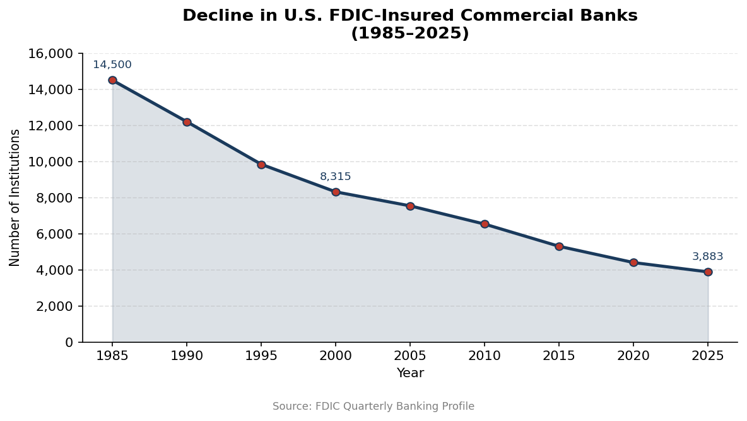
The U.S. banking industry has undergone extraordinary consolidation over the past four decades. In 1985, approximately 14,500 FDIC-insured commercial banks served the country. By the second quarter of 2025, that number had fallen to 3,883—a 73% decline driven by mergers, failures, and the punishing economics of operating a smaller institution. The surviving institutions are larger and more geographically diversified, but also significantly harder to manage.
Scale begets process. Process begets bureaucracy. Bureaucracy begets a culture in which activity is routinely confused with results. In a large regional bank, a well-intentioned initiative can spend months navigating compliance committees and technology governance panels before a single product change reaches a customer. Traditional risk aversion complicates the process, as anything new is viewed as risk increasing and resistance to change becomes the norm. Overall, the meetings multiply, the accountability diffuses, and execution suffers.
The regulatory overlay intensifies this bureaucracy dynamic. The Dodd-Frank Wall Street Reform and Consumer Protection Act of 2010 imposed sweeping compliance obligations on depositories above $10 billion in assets—stress testing, enhanced capital requirements, resolution planning, and expanded consumer protections. Although the current administration has lightened the supervisory posture at the margin, the regulatory framework and required compliance infrastructure remains substantially intact. For regional banks, risk management departments that once numbered dozens now number in the hundreds, consuming talent and capital that might otherwise fund product development or customer acquisition.
There is also a subtler, more pernicious dynamic embedded in the bank income statement. Loans are accrual assets: once booked, loans generate a predictable income stream that requires relatively little active management until maturity or default. As such, fixed-income assets can foster institutional complacency—an environment in which executives comfortably spin ideas in committee rooms while the contracted revenue keeps arriving. Often the urgency to execute is never quite acute enough to overcome institutional friction.
The Experience Gap: When the Talent Leaves, So Does the Judgement
Banking, at its core, is a judgment and risk management business. Credit underwriting, relationship management, and risk pricing all depend on practitioners who have seen enough cycles—enough booms, enough busts, enough restructurings—to recognize patterns that no model fully captures. That institutional wisdom is leaving the industry faster than it is being replaced.
The exodus has multiple drivers. Consolidation itself is partly responsible: as banks have merged, specialization has deepened and generalist experience has narrowed. A bank officer who would have overseen the entire credit process at a mid-size regional bank in 1995 now manages a narrow slice of a workflow segmented across half a dozen departments. The whole-institution perspective—the ability to see how funding costs, credit quality, interest rate risk, and operational efficiency interact—is increasingly concentrated in a shrinking cohort at the top.
External industries have accelerated the drain. Private equity and private credit platforms, flush with the $2.62 trillion in dry powder that the industry had accumulated by mid-2024, have systematically recruited senior banking talent—credit officers, relationship managers, and capital markets professionals. These non-bank platforms can often offer pay packages that publicly traded depositories cannot match. Technology companies have done the same—absorbing risk, data, and product talent into roles that carry neither regulatory constraint nor public scrutiny.
The downstream consequences are measurable. After the banking industry reduced headcount in 2023, 60% of displaced professionals moved into other industries and did not return when conditions improved, according to data tracked by executive search firms. By 2025, finance organizations were posting three senior roles for every entry-level position—a ratio that signals pipeline collapse. The experienced practitioners who remain are stretched thin, and the bench of upcoming talent capable of executing at a senior level has shrunk considerably.
The experience gap does not show up immediately in charge-off rates or return on equity. It shows up in the missed product innovation that a more rounded executive team might have pursued. It drives a slow erosion of underwriting discipline at the margin. And certainly, it erodes the ability to attract and retain clients that increasingly have sophisticated non-bank alternatives. Overall, dispersing finance talent outside the banking industry is a significant handicap for regional institutions trying to compete.
The Stakes
None of these threats alone is fatal. Regional banks have navigated technological change, competitive disruption, and regulatory upheaval before. The industry’s history is, in many respects, a story of survival against repeated predictions of obsolescence.
What is different today is the simultaneity and speed of these threats. Technology change, non-bank competition, funding disintermediation, governance complexity, and talent attrition are not arriving sequentially. Rather these threats are a converging existential crisis. A regional bank that is behind on technology is also a less attractive employer, which worsens the talent gap, which slows the technology response, which makes the institution less competitive for deposits, which constrains the capital available for transformation. These feedback loops run in the wrong direction (i.e. “wrong-way risk”).
Regional banks that survive the next decade will be those that recognize this convergence for what it is: an opportunity. These threats are not a set of discrete problems to be managed in separate committees. Rather, addressing these threats requires the kind of whole-institution clarity that has always been the regional bank’s advantage over its larger competitors. Regional banks should be nimble and differentiate with a practical strategy to address these converging threats head-on. It is what clients that depend on the regional banks require to continue driving innovation and productivity for the community.
Endnotes
1. Technology
• Reuters, “COBOL Blues,” https://www.reuters.com/graphics/USA-BANKS-COBOL/010040KH18J/
• COBOLpro, “Why COBOL Remains Mission-Critical: 2024 Statistics from Banking, Insurance & Government,” 2024.
• McKinsey & Company, Global Banking Annual Review, 2025; reported via CIO Dive, “AI Adoption Will Trim Banking Industry Costs by Up to 20%.” https://www.ciodive.com/news/ai-trim-banking-industry-costs/804341/
• Statista / IDC Financial Services Technology Report, 2025. https://www.statista.com/topics/7083/artificial-intelligence-AI-in-finance/
• Statista, “AI Profit Impact in Banking Worldwide Forecast,” 2025. https://statista.com/statistics/1560141/ai-profit-impact-in-banking-worldwide-forecast
2. Non-Bank Competition
• Mordor Intelligence, Private Credit Market Size & Share Outlook to 2031, 2025. https://www.mordorintelligence.com/industry-reports/private-credit-market
• SkyQuest / Business Research Insights, Fintech Lending Market Forecast to 2033, 2024. https://www.skyquestt.com/report/fintech-lending-market
• Slavic401k / MX, “Big Tech Financial Takeover: How Apple, Google, and Amazon Are Reshaping Money,” 2020. https://slavic401k.com/?p=3652
• CTO Magazine, “The Fintech Big Tech Convergence”
• American Banker, “Amazon, Apple, Google, Meta and X’s Latest Forays into Finance,” 2024-2025. https://www.americanbanker.com/list/amazon-apple-google-meta-and-xs-latest-forays-into-finance
3. Funding Model
• FDIC / S&P Global Market Intelligence, Deposit Market Share Data, 2024. https://www.spglobal.com/market-intelligence/en/news-insights/articles/2024/7/us-regional-bank-deposits-come-back-under-pressure-in-q2-2024-82503563
• Fiskil, “Top U.S. Banks by Total Deposits in 2024.” https://blog.fiskil.com/top-us-banks-total-deposits-2024
• Oliver Wyman, “How the Stablecoins Boom Is Reshaping the Power of Banks,” January 2026. https://www.oliverwyman.com/our-expertise/insights/2026/jan/navigate-stablecoin-impact-future-of-banks.html
• Bank of America Q4 2025 Earnings Call (Brian Moynihan, CEO).
• TechTimes, “Banks Rush to Tokenize Deposits as Stablecoin Networks Beat Them to Shared Payment Rails,” August 2026. https://www.techtimes.com/articles/324351/20260813/banks-rush-tokenize-deposits-stablecoin-networks-beat-them-shared-payment-rails.htm
4. Internal Governance and Controls
• FDIC Quarterly Banking Profile, Statistics at a Glance, Q2 2025. https://fdic.gov/quarterly-banking-profile/statistics-glance-industry-pdf-second-quarter-2025.pdf
• FRED, Federal Reserve Bank of St. Louis, QBPBSNUMINST series. https://fred.stlouisfed.org/series/QBPBSNUMINST
5. Experience Gap
• McKinsey & Company, Global Private Markets Report 2025 — Private Credit. https://www.mckinsey.com/industries/private-capital/our-insights/global-private-markets-report/private-credit
• ProspectRock Partners, “The Investment Banking Talent Wars: Inside Q4 2025’s Perfect Storm,” Q4 2025. https://prospectrockpartners.com/the-investment-banking-talent-wars-inside-q4-2025s-perfect-storm/
• BambooHR, “The Finance Talent Bubble Is at Risk of Bursting in 2026,” April 2026. https://www.bamboohr.com/resources/data-at-work/data-stories/april-finance-2026