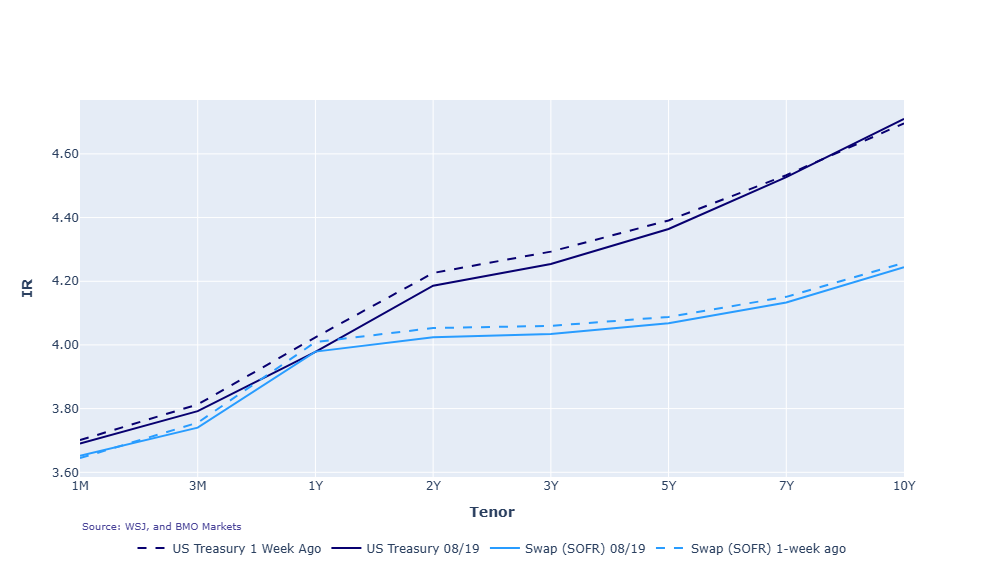
- Rates: Both Treasury and SOFR swap rates declined across most of the curve this week, with the largest drops concentrated in the 1Y–3Y range. However, the two markets diverged at the very long end: 10Y Treasury yields ticked up slightly while 10Y swap rates continued to fall, pointing to a modest widening in long-end swap spreads. This suggests broadly softer rate expectations overall, with some Treasury-specific pressure keeping the long end elevated relative to swaps.
- 30-Year Treasury Yield Hits 5.33%, Highest Since 2007: The sell-off comes as the U.S. annual deficit nears $1.8 trillion, while interest costs on the nation’s nearly $40 trillion debt are expected to reach $1.2 trillion this year. Rising government borrowing needs and persistent inflation concerns have pushed long-term yields higher, increasing borrowing costs for consumers and businesses and tightening financial conditions.
- Bank of America Invests $1.9B in Jio Credit, Mukesh Ambani’s Non-Bank Lending Arm: The transaction valued Jio Credit, the Mumbai-based non-bank lender, at $3.8 billion. Since launching in 2025, the company has grown rapidly as digital lending adoption has accelerated across India. Bank of America CEO Brian Moynihan called India “one of the world’s most important growth markets,” while Jio founder Mukesh Ambani said the partnership will help expand access to credit. The investment reflects an innovation strategy many global banks use in emerging markets: deploying capital through established local platforms to gain market exposure, build relationships, and participate in growth without the cost and complexity of building a large on-the-ground presence.
- Synchrony Financial Partners With OpenAI to Power Consumer Portals: The credit card issuer will deploy OpenAI’s latest models including GPT-5.6 across the enterprise through ChatGPT Work, Codex, and AWS Bedrock. Synchrony’s plugin lets consumers browse promotional financing and partner offers directly in ChatGPT. The partnership reflects a potential broader shift from traditional search engines and bank-owned digital channels toward AI-driven platforms, where consumers may increasingly discover and access financial products through conversational interfaces.
Rate Curves